
What Are Local SEO Services and Why Do They Matter?
When customers are ready to take action like booking, buying, visiting or calling, they conduct a local search.
Your business is probably losing out on customers if it’s not showing up in the map results or “near me” searches.
Consequently, local SEO isn’t just something nice to have; for a lot of sectors, it’s the quickest route to qualified leads.
Locally ranking is not just “doing SEO” with a city name added onto a page.
Which Businesses Benefit Most from Local SEO?
It is a coordinated system of signals from the Google Business Profile, on-site location signals, high-quality, consistent citations, reviews, and user experience that makes you an easy choice for search engines and customers.
When your pieces aren’t aligned, the most frustrating thing happens: impressions without clicks, traffic without calls, and leads that aren’t right.
This guide explains what modern local SEO services are made up of, how results are built, and how to choose an agency partner.
You will also discover how to steer clear of the mistakes that prevent businesses from making it into the local “3-pack” and onto the map.
Are you eager to turn local search strings to measurable revenue? If yes, use the art below and build from that.
What Is Local SEO?: How Nearby Searches Become Customers
Local SEO is the process of optimizing visibility for local-oriented searches so your business appears for searches on services near me or in a certain city.
This site was designed for businesses that service a certain area. Whether you have a physical store, a radius of service, or multiple locations.
If you are capable of doing it effectively, it connects your brand with a clientele that already has significant purchase intent and is looking for a nearby solution.
As per industry research, local search behaviour is conclusive; many people conduct mobile local searches and within one day make a call or go visit.
This is why many categories find that local SEO has a higher lead quality than top of funnel.
Accurate listings, strong location pages, and good reviews will help you rank but bad ones will break conversion even if you do rank.
We don’t need general traffic but more appropriate traffic from more appropriate service areas.
Top local SEO services ensure visibility and lead generation go together as an ongoing process instead of separate projects.
Which Businesses Benefit Most from Local SEO?
Local SEO is especially powerful for SMBs, home services, healthcare practices, legal firms, restaurants, and retail and any brand competing within a service radius. Every location can win its own set of “near me” moments, making it a major growth lever for multi-location and franchise organizations. This could impact your earnings if you rely on receiving calls, appointment requests, foot traffic, or local deliveries.
Local SEO vs Traditional SEO: What’s the Difference?
Traditional SEO targets general keywords and themes on a national level. On the other hand, Local SEO is focused on geographic pertinence as well as trust signals: proximity, verified business data, map visibility, and reputation. While high-quality pages and sound technical SEO basics are still a must, local ranking relies heavily on how Google interprets your physical business.
The Most Important Local SEO Ranking Factors
The local search results from Google utilize a combination of relevance, distance and authority signals to provide a simple answer to the following question: “Is this the best option nearby for this search query? ”
.
Both your website content and off-site confirmations, such as business listings and customer reviews, matter.
.
Your Google Business Profile is often the centerpiece as it feeds Google Maps and many local search features.
Clicks, calls and directions represent engagement signals that tell Google if your listing is useful
Technical issues which slow down your site or confuse crawlers can stifle performance across locations and service pages.
Successful campaigns focus on all signals and ensure that all signals remain healthy month after month instead of chasing ‘one trick.’
This is how you can achieve stable rankings instead of a temporary spike which goes missing after some latest update.
A potent local SEO plan emphasizes the signals that increase rankings and conversions, not either one or the other.
Let’s Talk on how we can
make your sales 10X
Are you prepared to create a professional website that increases conversion? Contact us now to work with the best website development consulting team.
Relevance, Proximity, and Prominence Explained
Relevance is how closely your pages and profile align with what the searcher seeks. Proximity describes how physically close the business is to the searching user or the place referenced by the query. Brand prominence entails credibility, which is reflected in customer reviews and other citations. You can’t change the physical distance, but you can definitely change the relevance and prominence with the right optimization plan.
Why User Experience Influences Local Rankings
Even when you rank, customers still need to choose you. You will lose conversions if a site lags in loading, contact options are ambiguous, and landing page does not correspond to search intent. Weak engagement rate will hinder growth over time. Local SEO isn’t “set it and forget it.” It can benefit from ongoing refinements to your page experience, calls-to-action, and offer clarity.
Google Business Profile Optimization for Higher Map Rankings
GBP lets you manage how your business displays and the information available to customers who are searching for it.
In some searches, the map appears before the organic results, meaning GBP can influence your lead volume immediately.
Your profile must be fully optimized to help Google understand what you do, where you do it and why you are trustworthy.
Customers are able to quickly make decisions looking at the hours, services, photos, and reviews without any clicks.
Often being seen and being chosen often comes down to the difference between “claimed” and “optimized” .
Multi-location businesses can gain a competitive advantage when their profiles get managed well.
Like other online channels, Local SEO services ought to treat GBP as a live channel maintained, refreshed, and measured.
One of the quickest local wins available is improving your GBP with a weak map presence.
Optimize Your Google Business Profile for Better Visibility
Make sure you have the basics right like the correct primary and secondary categories, complete service listings, correct hours, and consistent business information. Make sure to add important attributes for your industry, update your holiday hours, and check your website link and phone number. It is important to configure your service-area settings correctly to avoid creating confusion or violating your policies if you serve customers at their location.
Using Photos, Posts, and Q&A to Increase Engagement
Active profiles perform well as they appear updated to Google and customers simultaneously. By posting updates, adding new photos, and managing Q&A, you can boost engagement and lower friction for high intent searchers. Having a simple routine of monthly photo updates, regularly posting, and being proactive about Q and A can make a difference, especially in more competitive local markets.
What Is SEO? A Complete Guide to Search Engine Optimization, How Search Works, and a Practical SEO Roadmap For 2026
Local Citations and NAP Consistency Explained
What Are Local Citations?
Citations are mentions of your business across directories, maps, and platforms that confirm your name, address, and phone number (NAP).
When there are inconsistencies within those details, and you confuse the search engines and the customers, your ranking power and trust get diluted.
When they are accurate and widespread, they increase credibility and enhance your chances of ranking throughout a target area.
Citations might not sound appealing, but they are essential for businesses with a history, a move, or multiple listings.
It is important for conversion purposes. Prospects will check various sources before calling; inconsistency creates doubt.
An effective local SEO campaign should include building quality citations and correcting inaccurate citations over time.
Local results can be defined into deep pockets after a professional cleanup even with no major changes to the site.
Imagine citations as your “business identity layer” across the local web.
Where Citations Actually Live and Which Ones Matter
Citations can come from large data aggregators, essential platforms that are often maps and main directories, as well as industry-related listings. The objective is not to become omnipresent everywhere; it is to be present in the spaces that customers and search engines trust the most for your category. Using niche directories can work, when the directories are relevant and trusted – like professional services and home services.
How to Fix Duplicate Listings and NAP Errors
Because of old phone numbers, prior addresses, merged locations, or inconsistent naming, many businesses have duplicates. A citation audit will identify these conflicts and prioritize the fixes with the greatest impact. It can also suppress duplicates that confuse the search engine. When governance is weak, a mistake in one listing could replicate in dozens for franchises and other multi-locations brands, making this work important.
On-Page Local SEO Strategies That Generate More Leads
The website gets local interest to become a call, a booking, or a purchase, so on-site local SEO must support conversion, not just indexing.
It begins with explicit service pages, location pages when necessary, plus content that informs searchers in every marketplace.
Geo-relevance should feel natural: it’s about serving local needs, not stuffing city names into every sentence.
Internal linking occurs when links go from one page to another page of the same domain. It’s a link from one page to another page of the same main domain, helping website owners establish site architecture with a clear hierarchy.
Local schema markup helps reinforce your business data and helps search engines understand your data better.
Landing pages should make it easy to contact you quickly in particular on mobile.
Multi-location brands must create page templates that are both the same and different to avoid thin, duplicate pages.
If done right, on-site improvement can increase rankings and conversion rate at the same time.
Creating High-Converting Location and Service Pages
One common mistake is duplicating dozens of irrelevant city pages that add no additional value. Don’t choose page types because of how industry standards say you must page your business. local business should: create location pages if you have physical branches, service-area pages if you service a radius-based area, and city pages only if you can provide genuinely helpful, location-specific content. The best structure is the one that aligns to your and your user’s actual intent.
Local Schema Markup, Internal Linking, and Mobile Optimization
Using local business schema, putting review markup where possible, and having consistent NAP details help to reinforce local relevance. The pages of your website are clearly connected through site structure internal linking.
The performance of your website matters since local searches are skewed to our mobiles. Faster loading, click-to-call buttons, and frictionless forms can impact lead volume.
Online Reviews and Reputation Management for Local SEO
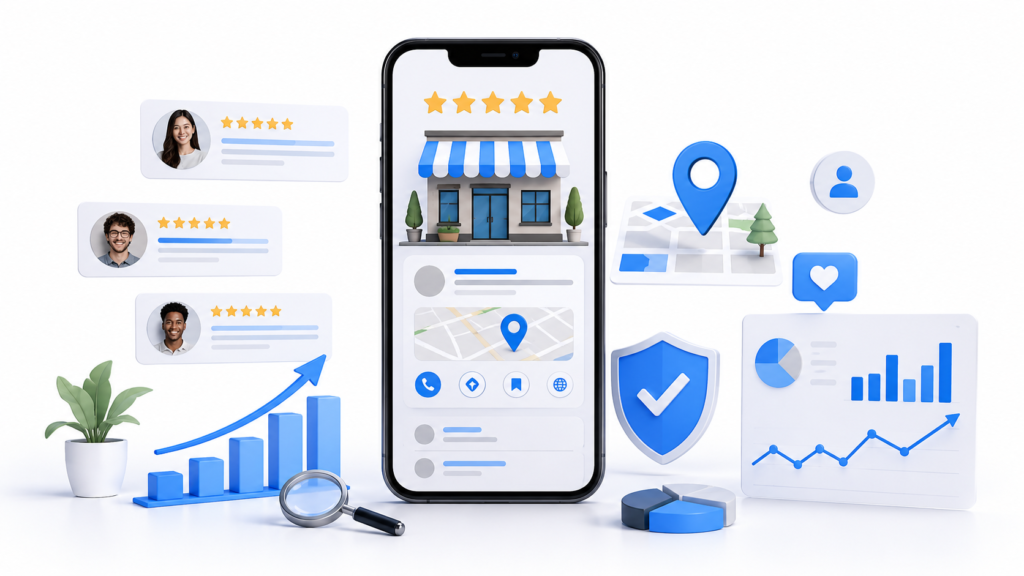
Reviews impact both rankings and conversions as they serve as evidence when customers compare local options.
Many buyers check reviews before picking a local supplier, with even a tiny rating or volume difference deciding on who gets the call.
Your reputation is not just about getting reviews; it is about the system there is behind review generation, monitoring, and responses. Constantly earning positive reviews is often far
more important than a few sudden large increases, because it shows everyone that customers are buying and using your product. It is also about diversity: varied platforms and a steady stream of feedback will enhance credibility.
Ignoring negative reviews can be a grave mistake, as one’s silence may be taken as indifference. Moreover, in retrospect, research showed that negative reviews are not that damaging.
Local SEO services should consist of a workable strategy for getting reviews and a reply process that safeguards your brand.
A well-managed reputation reduces friction in the sale process and boosts conversion in every channel, not just SEO.
How Customer Reviews Influence Local Rankings
A sustainable feedback program promotes getting reviews from customers post-success after service delivery or appointment completion. It also avoids shortcuts that risk policy violations. The goal is simple: create a regular downpour of genuine reviews that convey your positive qualities, helping to establish and strengthen your position to get you noticed.
Best Practices for Managing and Responding to Reviews
When you reply to reviews, whether good or bad, it shows your business is active and responsible. A good playbook establishes tone, timing, and escalation guidelines for a consistent team response across locations. It also converts feedback into operational insight, allowing you to identify recurring issues that quietly damage conversion rates.
Building a Local SEO Strategy That Drives Consistent Leads
When organisations think of their Local SEO as a lead-generation system, not just a list of things to do, it is super effective.
It all begins with an audit of your baseline: your rankings, your listings, your on-site performance, and the health of your conversion path across devices..
Next comes targeting by intent geo-modified queries, service keywords, and “near me” patterns that show how people really search.
You optimize the Google Business Profile, clean up citations, and make on-page improvements to ensure that all signals support the same service areas and offers.
Now, you measure the things that are most important like the calls, form submissions, booked appointments, quality of leads and not only the amount of traffic you are getting.
After the engine is stable, you scale with content, link building, and reputation growth to fortify reality.
The method works well with CRO and paid search as CRO and paid search are improved landing pages that raise ROI overall.
The outcome is a campaign that generates short-term victories that you can measure while also compounding over time.
Tracking Calls, Forms, and Local SEO Performance
A useful setup includes clear form and call tracking with conversions, UTM standardisation for campaigns, and landing pages tailored to local intent. If phone calls are the lifeblood of the business, call tracking and call quality monitoring can improve decision-making by leaps and bounds. The aim is to find where, which service, and which page generates good conversations and spend more.
How to Choose the Right Local SEO Agency
When looking at what problems an agency can actually solve, process and accountability matter more than the size of the service list.
A reputable partner must explain what first they will do, and why that work is important, and what success will look at 30/60/90 days.
They ought to be open about what local SEO can do and cannot do, especially regarding timelines and competitive markets.
Check their audit method, documentation, reporting rhythm, and multi-site complexity for operational strictness evidence.
Do expect education and not secrecy; the best partners will help you understand the ‘why’ behind each action.
After all this, ensure the agency’s work ties back to business results like calls, bookings, and revenue, not just rankings.
Don’t just outsource Local SEO! Treat the selection like a strategic decision.
If you choose the right partner, local becomes one of the most reliable growth channels in your marketing mix.
Questions to Ask Before Hiring a Local SEO Company
Here are some insightful questions that reveal how an agency operates (and whether they are built for results).
- How can the Google Business Profile, citations, reviews, and on-site local signals be audited and what does the first month look like?
- Which conversion actions are you tracking (calls, forms, bookings) and how will you report on lead quality?
- How to avoid duplicate listings, NAP inconsistency and thin location pages; all when dealing with a multi-location brand?
- What else is done apart from the basic setup?
