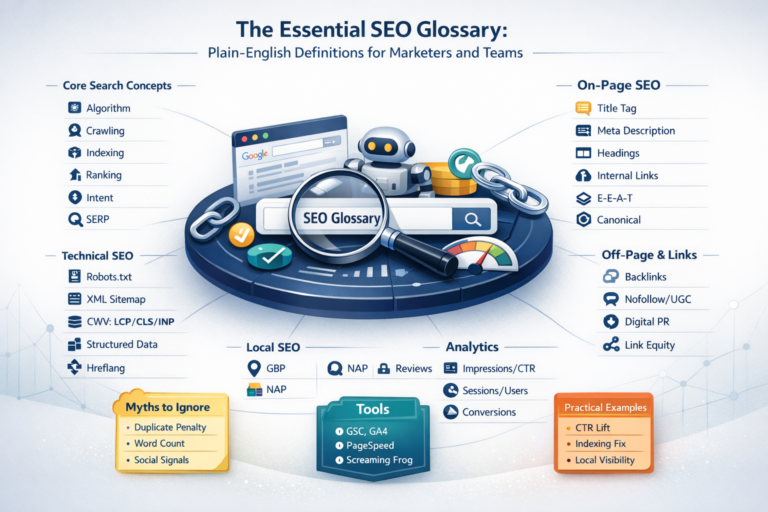
Introduction.
SEO is the process of improving your digital content usability, relevance and visibility so that search engines are confident about recommending it. SEO stands for search engine optimization.
Simply put, it’s a practice that envelops everything from your site architecture and page speed to information design, author signals, and how your brand earn mentions all over the web. And it applies to more than web pages. The search engine said video, photo, business profile, product listing or other asset could show up in Google search. People judge the importance of any information which they see online through organic search. By applying SEO techniques you can ensure that people find, trust, and choose your content. Thus, knowing what is SEO as well as applying it consistently is what enables others to find you.
What SEO Actually Does for Your Business (H2).
The value of SEO is compounding. A well-written article that solves a problem or a product page that clearly maps to buyer intent can earn steady traffic well after publish. Qualified traffic refers to traffic that was already searching for that; as such, qualified traffic usually converts better than unqualified channels. Furthermore, appearances in search contribute a trust effect. Something that appears consistently in high prominence creates credibility in a prospect’s mind before they arrive on your site.
- Links and clicks continue to be generated over time for evergreen content.
- The quality of pipeline is enhanced as visitors have a purpose.
- A natural click diminishes the need for paid media for each click thus reducing blended CAC.
- Search engines continue to see you because you rank for similar keywords, confirming your authority.
How Search Engines Work: Crawl, Render, Index, Rank (H3).
Crawl and discovery (H3).
Search engines use automatic bots that find URLs with internal links, external links, and sitemaps. A page that’s buried, orphaned, or blocked isn’t going to be found reliably. Make important pages easy to reach and easy to follow.
- Make sure that important pages don’t take more than 3 clicks to reach.
- Always update your XML sitemap and inter connect new pages with existing ones.
- Make sure there aren’t any damaged links or extensive redirect chains that squander crawl budget.
Rendering and indexing (H3).
Discovery isn’t enough. For the site page to be indexed, Google has to fetch and render your page (along with its JavaScript) to understand its content. If you use clean HTML, clear headings and consistent canonicals on your pages, you will reduce confusion.
- Utilize server-side actions or pre-rendering for experiences heavy on JavaScript.
- Use the URL Inspection Tool in Search Console to verify HTML.
- Merge similar products with smart parameters by using canonical tags.
Ranking and retrieval (H3).
When a person searches, algorithms look through the indexed pages to see which pages most closely satisfy the moment’s searcher intent. Different factors are used to determine page position by Google. A user’s context such as their device and location, and freshness needs is key.
- Publish pages that truly show the best answer for the query.
- Demonstrate your expertise through personal experience, evidence or writing.
- Have your pages load fast, run stable, secure and make the format like the 1st page of Google.
The Three Pillars of SEO and How They Interlock (H2).
Technical SEO (H3).
The technical work ensures that a user can find your site and its pages faster on mobile and tablet devices. There is no doubt that having architecture and performance in any digital medium is important.
- The URLs are short but clean and all on HTTPS.
- Fixing image, CSS, and JS problems should be your top priority if you want to improve LCP, CLS and INP.
- Structured data provided by schema for better understanding and earning rich results.
On-Page and Content SEO (H3).
On-page actions associate a page with a real search need and make that relevance clear. Before any machine decode your signals, cater to your customers first.
- Use titles and meta descriptions that promise benefits and set clear expectations.
- Headings show the reader where our story is heading, body copy shows our experience and depth.
- Links within your site that offer direction to users and link related concepts and next steps.
Off-Page SEO (H3).
Your trustworthiness increases when recognized authorities cite or link back to your work. These signals guarantee that your brand is trustworthy regarding a subject in the eyes of a search engine.
- Online PR, unique information, expert opinion and partnerships.
- It’s better to have fewer quality links than having all the top position links for searchengines.
What Users Seek when Searching Matter as Much as What Searches Type.
Keyword matching alone isn’t enough. You must satisfy the “job to be done” behind the query. Analyze the pre-existing results to identify patterns if any, such as whether the result is a deep guide, comparison page or product listing. Align your content type and depth accordingly.
- What is the schema markup meaning?
- Look into the best email marketing software.
- Transactional: “buy ergonomic chair”.
- Navigational: “ahrefs login”.
Changing Keywords: Choosing Which Topics to Create Pages For.
Start with real questions from customers. Sales call, support ticket, community thread. Keyword tools help find related terms, synonyms, and long-tail versions. Organize individual pages by topic and goal so each one can dive deep rather than compete with its own material.
A simple flow.
- Collect seed topics from customer conversations and competitor top pages.
- Expand into related queries and questions; group by intent and theme.
- Evaluate click potential by inspecting the SERP, not volume alone.
- Prioritize terms that align closely with business value and realistic difficulty.
- Map one primary keyword per page with 3–6 semantically related secondaries.
On-Page Optimization: Indicating Relevance without Stuffing (H2).
Titles and meta descriptions that earn the click (H3).
Lead with clarity and value. Your title should express the main idea and who benefits. It is a good way to write your meta description- can preview what the reader will learn or do next.
Headings, copy, and content design (H3).
Use H2s and H3s to guide the narrative. State the answer first, then state the details, examples and exception. Using tables, short summaries and checklists are helpful for scanners and still support deep reading.
Internal links that move users forward (H3).
Anchor text should describe what’s on the other side. Use important pages to link to these important pages and make them authoritative. The navigation for users would be improved and moreover the search engine relevance will be disseminated by doing this.
Media and accessibility (H3).
Make your images better (like, WebP/AVIF, compression, descriptive filenames) and write alt text. Make sure that there are transcripts and chapters if there is a video. Use suitable VideoObject schema when applicable.
Technical Foundations That Move the Needle (H2).
Architecture and URLs (H3).
A well-structured site feels intuitive. Topics with meaningful connections live close together, breadcrumbs reflect the hierarchy and URLs – short, descriptive & stable.
- Instead of Parameters and Session IDs, opt for /category/topic.
- make sure you use lower case and add trailing slash
- Use breadcrumb markup and clear pagination patterns.
Speed and Core Web Vitals (H3).
Performance is user experience. Faster sites rank and convert better.
- The relevant metrics of Largest Contentful Paint, Cumulative Layout Shift and Interactiveness.
- We should serve next-gen images and add a dimension to avoid layout shifts.
- Put Off Unneeded JavaScript Elements And Use Fewer Scripts.
JavaScript SEO basics (H3).
Place important content in the first few HTML lines. Ensure that link are crawlable (anchor tags have hrefs) and avoid infinite scroll through URLs instead of pagination.
Structured data essentials (H3).
Schema clarifies meaning and can unlock rich results.
- Article/BlogPosting, FAQPage/HowTo, Product/Offer/Review.
- Organization/LocalBusiness, Breadcrumb, VideoObject.
- Regularly verify with Google’s rich results test.
Index management and duplication control (H3).
Focus the index on the right versions of the right pages.
- Utilize canonical tags for duplicate pages and noindex low-value utility pages.
- Link to Related Pages, Redirect Old Link
- Make use of canonicals and Search Console rules to handle parameters.
Sitemaps and robots (H3).
Give crawlers a clear map and don’t block essential assets.
- Make different sitemaps for different content types and receive them per publication update.
- Your robots.txt must not block any CSS or JS required for rendering.
Gaining credibility on the open web through authority and link building.
What a quality link looks like (H3).
Using discretion, placing in context and relevance rating is far more essential than count. Having one link from a trusted site that is relevant to your topic is far better than hundreds of links from a reputable, but irrelevant site.
Practical acquisition ideas (H3).
- Make available original data that others want to cite; for example, surveys and benchmarks.
- Give skilled commentary to journalists and industry publications.
- Collaborate with brands that would do a podcast, webinar or guide with you.
- Restore your brand mentions and change out any broken links.
Practices to avoid (H3).
The use of many low-grade guest posts, link buying schemes and over-optimised anchors can cause harm. Earn authority; don’t fabricate it.
Local and International SEO Essentials (H2).
Local SEO (H3).
If you serve specific locations, then your Google Business Profile is critical. Keep a current profile that includes your categories, services, hours, photos, any Q&As, along with asking for and responding to reviews. Your name, address and phone number must be the same in every directory. Make sure your location pages are helpful and show that your business really exists and has real expertise. Don’t just swap out the city names.
International and multilingual (H3).
Use subfolders for easy scalability and add hreflang to connect equivalents. To emphasize their importance, the relevant examples and currencies have to be used. Localized support details and legal disclaimers are also present.
How We Capture and Convey Our Impact.
A KPI stack that ties to outcomes (H3).
It is important to track KPIs to measure the visibility, traffic, engagement and conversions for target keywords. Assess quality and downstream impact of leads if possible not clicks.
Tools and setup (H3).
- Google Search Console for checking the coverage and queries and seeing enhancements.
- Organic segment analysis and conversion analytics e.g. GA4.
- A keyword rank tracker which also shows Google SERP features.
- Use a crawler and log files to see bots crawl over your site and where they go.
Cadence and dashboards (H3).
You should review your data once a month and summarize the wins and losses, what changed in the SERP or on-site – and what committing to now for next experiments. Keep dashboards lean so decisions are obvious.
Create a plan for the first 90 days in the business.
1) For the first two weeks, audit baseline.
- Crawl the site, analyze Core Web Vitals, and check documentation over coverage/indexing.
- Assign a main keyword to all important websites. Do not have a keyword conflict.
2) For weeks 3 to 6, strengthen the foundations.
- Change the indexation errors and improve on titles, tags and headings.
- Use core templates for schema implementation; add internal links from authority hubs.
3) Week 7–10: Updating Your Journal.
- Make a small set of interconnected content pages (4 to 8 pages) on a single promising topic based on the analysis of the link profile.
- Refresh the old content with updated data and examples and UX redesign.
4) Weeks eleven to thirteen: Build authority and promote.
- Use authentic data or expert POV to create a low-cost digital PR angle.
- Please suggest 3 to 5 podcasts or publications.
Common SEO Mistakes to Avoid (H2).
- Concentrating more in quantity rather than quality and price.
- Empty content or pages that don’t add anything to SERP.
- Many website pages are ranking for the same keyword.
- Ignoring site structure and internal linking.
- Web pages that take long to load, load heavy javascript and ship empty HTML to crawlers.
- SEO is a term which equips your website or platform for better ranking in search engine results pages.
FAQs (H2).
How long does SEO take to work? (H3).
If you refresh your pages, you may see some results in a few weeks. However, typical growth takes 3-6 months. New domains and competitive terms require longer horizons.
Is SEO the same as PPC? (H3).
No. PPC generates instant visibility. SEO generates compound visibility. The teams placing ranges of bets. Some individuals pay for a speedy assessment and capture website, made to last for optimal performance and lower blended acquisition costs.
Which tools do I need to start? (H3).
Start with Google Search Console and your analytics tool. As you scale up, consider getting a crawler, a rank tracker, and a keyword research tool to prioritize and monitor results.
How often should I update content? (H3).
Refresh when SERP updates, performance drops or data gets old. If a subject is not time-critical, it can be reviewed yearly.
What is E-E-A-T and why does it matter? (H3).
Experience, Expertise, Authoritativeness, and Trustworthiness. Give us real-life experiences as well as honest sources. Reveal who created the content and check what others say. It helps users and aligns with modern quality signals.
In conclusion, be the best answer and make it easy to choose you.
SEO does not involve tricking search engine; rather, it involves a method to answer the real question clearly, showing expert and delivering the answer only on a fast and reliable site. Search Engines have a good enough reason to recommend you when you are aligned with intent and are communicating value while boosting trust signals across the web. So do our people to convert.